
AI is becoming incredibly good at generating content, answering questions, writing code and automating repetitive work.
And that is exactly why businesses are rushing to put AI into their operations.
Customer support.
Sales.
Finance.
Logistics.
Reporting.
Internal assistants.
Agents.
But there is an uncomfortable problem that gets ignored:
AI can automate a broken process just as efficiently as a good one.
Sometimes even faster.
The Automation Trap
Imagine a company with this workflow:

Someone proposes:
“Let’s add an AI agent.”
So the new architecture becomes:
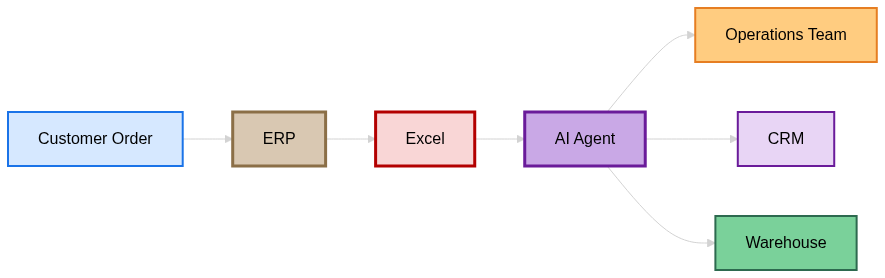
Congratulations.
You have successfully automated the chaos.
The AI Is Not the Problem
The agent may be perfectly capable.
The problem is the data environment around it.
If the business has:
- inconsistent data,
- duplicated processes,
- undocumented rules,
- stale integrations,
- manual reconciliation,
- fragmented systems,
then the AI agent is operating on unstable foundations.
The architecture needs to come first.
Build a Reliable Data Layer First
The better approach is:
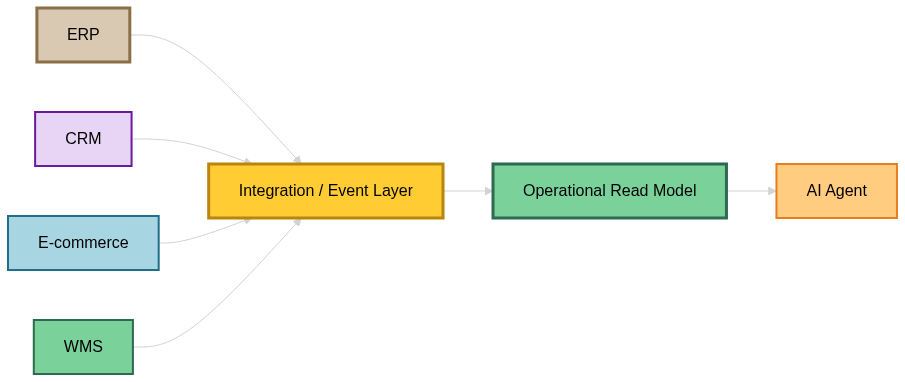
Now the AI does not need to understand four legacy systems.
It consumes a clean operational model.
That gives the agent:
- consistent data,
- predictable structures,
- controlled access,
- easier auditing,
- lower database pressure,
- and a much simpler integration boundary.
Don’t Give an AI Agent Your ERP
There is a big difference between:

and:

The first means the AI becomes another unpredictable client of your transactional system.
The second means the AI consumes a representation designed for queries.
That distinction matters.
A transactional ERP should be optimized for:
transactions.
A read model should be optimized for:
questions.
The Architecture We Prefer
For businesses with increasingly complex operations:
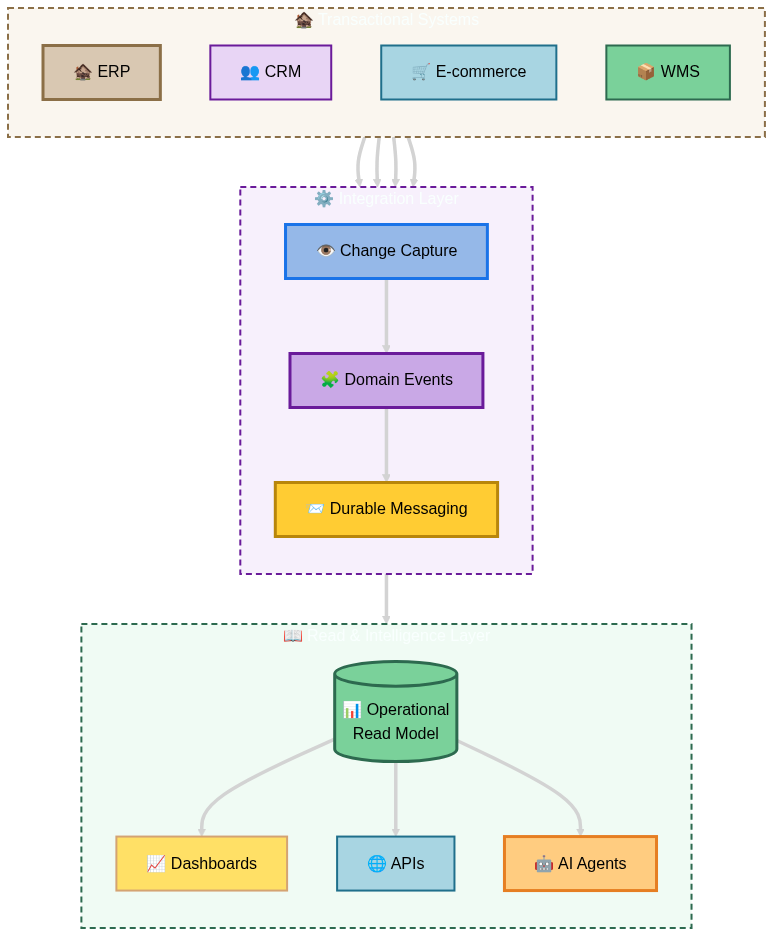
This architecture separates:
where the truth is written
from:
where the business asks questions.
That is one of the most powerful architectural changes a growing company can make.
AI Needs Fresh Data, Not Just More Data
Another common mistake is thinking that AI quality is primarily about the model.
For operational AI, data freshness can be much more important.
An agent answering:
“How many units do we have available?”
is useless if its data is six hours old.
An agent answering:
“Which orders are delayed?”
is dangerous if the shipment status is stale.
The question is therefore not:
“Can AI access our data?”
It is:
“Can AI access the right data, in the right shape, with the right freshness?”
That is an architecture problem.
The Business Case
A useful AI system should reduce operational friction.
Not add another dashboard.
Not become another person to maintain.
Not create another integration nobody understands.
The goal should be measurable:

The sequence matters.
Data first.
Architecture second.
Automation third.
AI on top.
The Rule We Use
Before adding an AI agent to an operational process, ask:
Is the underlying process reliable enough to automate?
Then:
Is the data reliable enough for a machine to make decisions from it?
And finally:
Can we isolate the AI workload from the transactional systems that run the business?
If the answer is no, adding an agent is probably premature.
What We Do at AR Solución Digital
We do not start with:
“What AI tool should we use?”
We start with:
“What operational problem are we trying to remove?”
Sometimes the right answer is an automation.
Sometimes it is an integration.
Sometimes it is an internal application.
And sometimes, once the underlying data flow is reliable, AI becomes an extremely powerful next layer.
The technology follows the operational problem.
Not the other way around.
AI should multiply a healthy operation.
It should not become an automated layer over an unhealthy one.