
There is a pattern we see repeatedly in growing businesses.
The company invests in a better ERP.
Then connects the e-commerce platform.
Then a CRM.
Then a warehouse management system.
Then finance.
Then dashboards.
Then automation.
And six months later, everyone complains that:
- stock does not match,
- invoices arrive late,
- orders need manual reconciliation,
- customers receive outdated information,
- and someone still has an Excel spreadsheet that “keeps everything aligned.”
The obvious diagnosis is usually:
“The ERP is too slow.”
Often, it isn’t.
The real problem is the architecture around it.
The Hidden Cost of Synchronous Integrations
Consider a simple order flow:
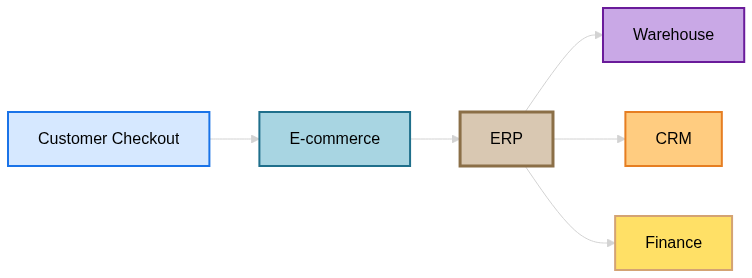
The system looks connected.
But what happens if Finance takes three seconds to respond?
What happens if the Warehouse API is temporarily unavailable?
What happens if the CRM returns an error?
The checkout process starts depending on systems that have nothing to do with accepting the customer’s payment.
Now a downstream outage becomes an upstream outage.
The Better Question
Instead of asking:
“How do we make every system respond faster?”
ask:
“Which systems actually need to be on the critical path?”
Usually, far fewer than people think.
A more resilient design looks like:
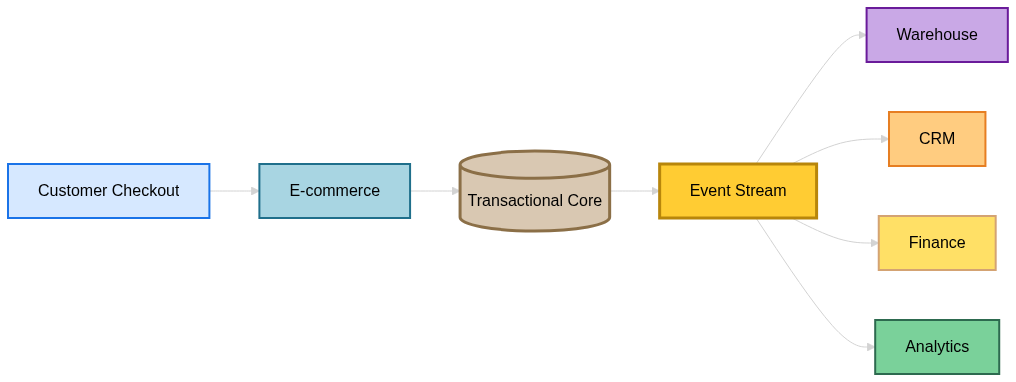
Now the customer transaction completes locally.
The downstream systems react asynchronously.
That changes the failure model.
A temporary CRM outage does not need to stop an order.
A delayed analytics process does not need to block checkout.
A warehouse integration can recover without forcing the customer to retry the purchase.
The Spreadsheet Symptom
One of the most reliable symptoms of an integration problem is not a server alert.
It is an Excel file.
When employees maintain spreadsheets to reconcile:
- stock,
- orders,
- invoices,
- customers,
- payments,
- or delivery status,
the company has usually created a manual integration layer.
The spreadsheet is not the root problem.
It is the symptom.
The actual problem is usually:
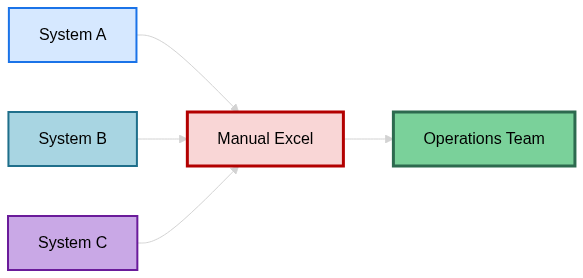
The employees are effectively acting as middleware.
They copy.
They compare.
They correct.
They reconcile.
Then they repeat the process tomorrow.
Replace Human Reconciliation With System Reconciliation
A better architecture moves reconciliation into software.
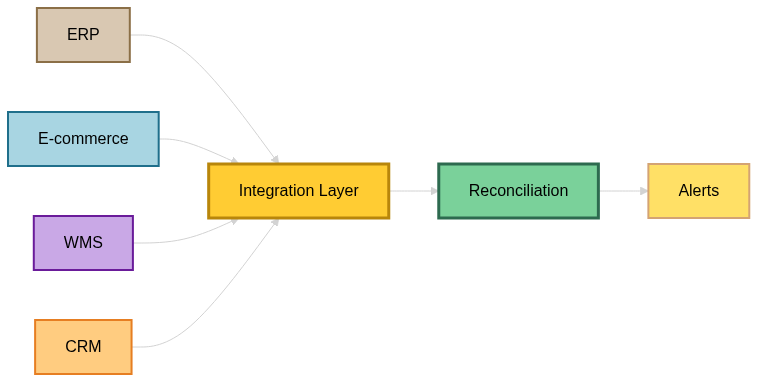
The system can then detect:
Order exists in e-commerce
but not in ERP.
Stock differs between ERP and WMS.
Payment exists
but invoice is missing.
Customer updated
but CRM is stale.
That is a much better use of engineering time than asking employees to discover these discrepancies manually.
Integration Is Not Just “Connecting APIs”
A production integration needs to answer much harder questions:
What happens when the API is down?
What happens when the same message arrives twice?
What happens when the request times out but the remote system actually processed it?
What happens when one system is 20 minutes behind?
What happens when a field changes?
What happens when the business grows from 100 orders per day to 10,000?
A reliable integration therefore needs things such as:
- retries,
- idempotency,
- reconciliation,
- dead-letter handling,
- observability,
- and explicit ownership of the data contract.
That is why an integration built in a weekend can become one of the most expensive pieces of software in the company two years later.
The Business Result
The objective of integration engineering is not:
“Make APIs talk to each other.”
The objective is:
Make business data move without requiring humans to keep it synchronized.
That produces tangible operational improvements:

Less copying.
Less reconciliation.
Fewer operational errors.
Faster information.
More predictable processes.
And, most importantly:
the company can increase transaction volume without increasing manual coordination at the same rate.
The Rule We Use
Before building another automation, ask three questions:
What happens when this system is unavailable?
What happens when this message is processed twice?
Who reconciles the system when something goes wrong?
If the answer is:
“Someone in Operations will fix it in Excel.”
then the integration isn’t finished.
The automation is.
The system isn’t.
What We Do at AR Solución Digital
We build integrations around the systems businesses already have.
ERP.
CRM.
E-commerce.
Warehouse systems.
Internal applications.
APIs.
And operational data.
The goal is not to replace everything.
The goal is to create reliable data flows around the systems that already run the business.
That can mean a simple integration.
It can mean an internal operational application.
Or, when the business has reached the next level of complexity, it can mean an event-driven integration layer.
The architecture depends on the problem.
The objective does not:
Less manual coordination.
More reliable data.
More operational capacity.